-
Step 1: Check the catalog revision date first
-
Step 2: Verify regulatory claims yourself
-
Step 3: Ask for sterilization validation data (and understand PCR)
-
Step 4: Match the material spec to your actual use case
-
Step 5: Get the full price in writing—including what's NOT included
-
Step 6: Run a communication test before you commit
-
Step 7: Vet the technology partners too
-
Errors I still see
If you're the person who has to approve medical device purchases—at a surgery center, a dental clinic, or a hospital procurement department—you've probably had this moment: a supplier slides a catalog across the table and says, "everything you need is in here."
I've been on the review side of that exchange for about 4 years now. I'm the quality compliance person at a medical device company. I check products before they reach clinicians—roughly 200 items a year. Actually, 180 last year. I'd have to check the system for the exact number. The point is, I've seen enough to know where the gaps hide.
This checklist is for non-scientists who still need to verify medical device quality without a full lab team. Here are the 7 things I verify before approving any product. (Should mention: this reflects what I've learned as of early 2025, so verify official data as you go.)
Step 1: Check the catalog revision date first
Before I look at any product detail, I flip to the last page of a catalog and look for the revision date. It sounds basic, but you'd be surprised how many people work from outdated documents.
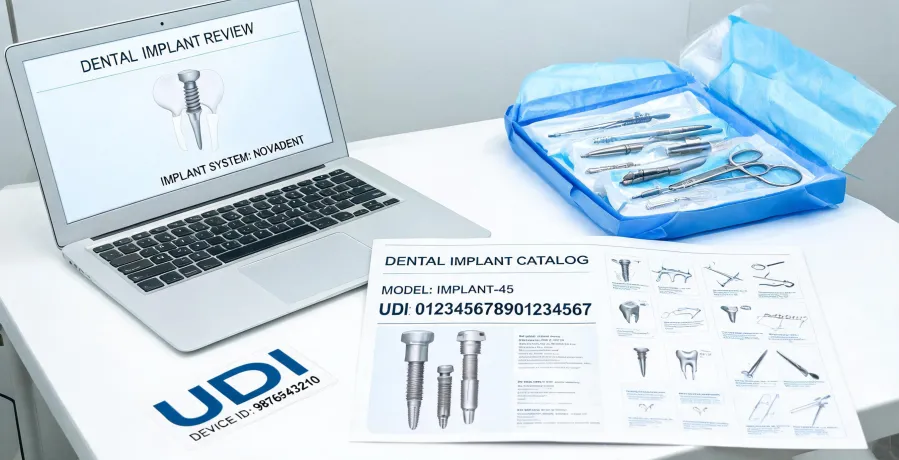
Take the Zimmer Biomet dental implant catalog. I use it as a benchmark because it shows the level of detail I want from any supplier. Each implant system lists the connection type, surface treatment, platform height, and surgical sequence. But those specs change. When a company retires part numbers or updates a technique, the catalog gets revised. If you're reviewing a 2023 catalog in 2025, you're making decisions on old data.
So the first check is simple: what revision date is printed on the catalog? Does the supplier send updates automatically, or do you have to ask? And if they can't tell you when the catalog was last updated, that's a red flag.
Step 2: Verify regulatory claims yourself
Don't take "FDA-cleared" at face value. I've learned that the hard way.
Per FTC guidelines (ftc.gov), advertising claims must be truthful, not misleading, and backed by evidence. "FDA-cleared" is an advertising claim. So I always ask for the 510(k) number and verify it in the FDA database before I approve anything. It takes five minutes.
I review surgical catheters pretty often, and this issue comes up more than it should. One vendor told me their catheter was "FDA-approved." When I asked for the 510(k), they went quiet. It turned out they were relying on a 510(k)-exempt classification and had never actually submitted a filing. Legal to sell, yes. But the way they presented it was misleading.
Step 3: Ask for sterilization validation data (and understand PCR)
This is the step most people skip, and the one I care about most. "Sterile" is not a fact. It's a claim. And the claim is only as good as the validation data behind it.
Before I go further, I should answer a question I get a lot: how does PCR work? PCR stands for polymerase chain reaction. It's a lab technique that amplifies tiny fragments of DNA so they can be detected. In sterilization validation, a swab is taken from a device after it goes through a medical sterilizer. If any microbial DNA remains, PCR makes it show up. No signal means the sterilization process likely worked. A signal means something was left behind—even if the device looks clean.
So when a supplier tells me their products are sterile, I ask:
- Which medical sterilizer was used, and what's the model?
- What were the cycle parameters—temperature, pressure, exposure time?
- Are biological indicators or PCR tests run on every batch, or only occasionally?
- Can I see the raw results, not a one-line summary?
A vendor once told me their products went through "standard sterilization." The document they sent had no temperature or pressure data. I couldn't verify anything. The product was probably fine, but "probably" isn't a quality standard.
Step 4: Match the material spec to your actual use case
This one cost me real money, so maybe I can convince you faster than I convinced myself.
A few years ago, I was reviewing a batch of surgical catheters. The supplier confirmed they used "industry standard material." I approved. Nobody checked the stiffness specs against our surgeons' technique, until one of them asked, "why is this catheter so stiff?" The product looked acceptable on paper. In practice, it was too rigid for the procedure. The whole batch got pulled.
The delay cost us around $18,000 between rescheduling and rush-ordering a replacement. (Which, honestly, hurt. But it was the best learning expense I've ever paid.) Now I don't accept vague descriptors. I ask for the material certification, the durometer reading, the dimensional tolerance range, and the specific test standard used. If a supplier can't provide those in writing, I assume they don't have them.
Step 5: Get the full price in writing—including what's NOT included
I've learned to ask "what's NOT included" before asking "what's the price."
Here's what happened. A vendor gave me a quote roughly 30% below the nearest competitor. I almost signed on the spot. Then the invoice arrived with separate line items for shipping, for sterilization documentation, for "expedited processing." The total ended up about 20% higher than the quote. The competitor who seemed more expensive upfront? Their bid included everything, which made them the cheaper option in the end.
So now my rule is simple: if a supplier won't put the complete, itemized total in writing before we commit, I walk away. This isn't about demanding the lowest price. It's about knowing the real number before the order, not after. A transparent price that's slightly higher beats a low quote with surprise fees, every time.
Step 6: Run a communication test before you commit
This one feels a little strange the first time you do it, but it catches problems early.
I once asked a supplier to ensure a product batch was "traceable to the sterilization run." In my head, that meant each box got a label with the sterilization cycle number. They heard "keep the paperwork somewhere accessible." The products arrived with no labels, and the paperwork—when we finally found it—didn't connect boxes to cycle numbers. We were using the same words but meaning completely different things.
The fix is simple: after you communicate a requirement, ask the supplier to repeat it back in their own words. "Just so we're on the same page, can you summarize what I need in a couple of sentences?" If their summary doesn't match your request, you've found a gap. Better to catch it before the order than after.
Step 7: Vet the technology partners too
This one matters more as devices get smarter. In orthopedics and dental, connected implants are no longer hypothetical.
Take the Canary Medical-Zimmer Biomet partnership, for example. The Persona IQ knee combines a Zimmer Biomet implant with Canary Medical's sensor, which tracks step count and range of motion and transmits the data to clinicians. When a connected product like this comes through review, I have to look at both companies. What data is collected? Who has access? How is it encrypted? What happens if the sensor battery dies? If either company is vague on those questions, the product doesn't get approved.
I use this example because it sets the bar for transparency. If a supplier can't clearly explain what their technology partners contribute, that's an opacity you shouldn't accept.
Errors I still see
A few last cautions, because this checklist isn't complete without them.
First, people over-trust catalogs. A catalog is a starting point, not a guarantee. I've rejected batches because a product was "close enough" to what we asked for. Close enough isn't a spec.
Second, data goes stale. Everything in this article reflects what I knew as of early 2025. The medical device landscape changes fast—products get cleared, partnerships shift, standards evolve. Always verify current status on the FDA's 510(k) database and check for updated guidance at ftc.gov.
Third, define your standards explicitly. A supplier's "standard sterilization" might be a gravity-displacement autoclave at 121°C. Your facility might use a vacuum-assisted cycle at 134°C. The word "standard" hides a lot of variation. Write down exactly what you need, and make the supplier confirm it.
Oh, and one more thing I should mention: I didn't always follow this checklist. I used to trust supplier-provided specs and move fast, until the $18,000 catheter batch taught me otherwise. Some lessons you have to pay for. If you're earlier in your career than I am, hopefully this saves you the tuition. (Mental note: I really should update our own training deck on this.)

Leave a Reply