Last April, I spent an entire Tuesday afternoon with a 47-page PDF and a coffee that went cold. The PDF was the Zimmer Biomet Arcos surgical technique. I wasn't reading it because I'm a surgeon. I'm not. I'm a quality and compliance manager at a regional medical device company, and I review roughly 200 clinical and marketing items a year before they go out the door. I've rejected roughly 12% of first deliveries in 2024 due to spec mismatches.
Before that afternoon, I had a fairly simple rule: if a document came from a recognized manufacturer, I checked the revision date and moved on. The word “official” carried a lot of weight with me. Then a near-miss changed that.
Official is not the same as accurate. Official is not the same as current.
The trigger no one likes to talk about
In March 2024, we prepared a quote that referenced a surgical technique guide from a different vendor—not Zimmer Biomet, but a big name. The guide included a plate specification that had been discontinued two years earlier. Our salesperson caught it during an internal review before the quote went out. It didn't reach a customer. It still cost us: three hours of rework, a rushed approval chain, and a new checklist.
That checklist was the useful part. We added one question to every review: Is this the version the manufacturer's corporate office recognizes as current? The question sounds simple. It isn't. Every manufacturer publishes this information a little differently. And when I looked at the Zimmer Biomet Arcos surgical technique, I realized something: the document was verifiable, but only if you knew where to look.
What the Arcos surgical technique taught me
The Arcos surgical technique is a manual for a modular femoral revision system. It is not a light read. It has diagrams, torque values, sizing steps, and warnings that assume you know the anatomy cold. I don't know the anatomy cold. What I do know is what a good instruction set looks like.
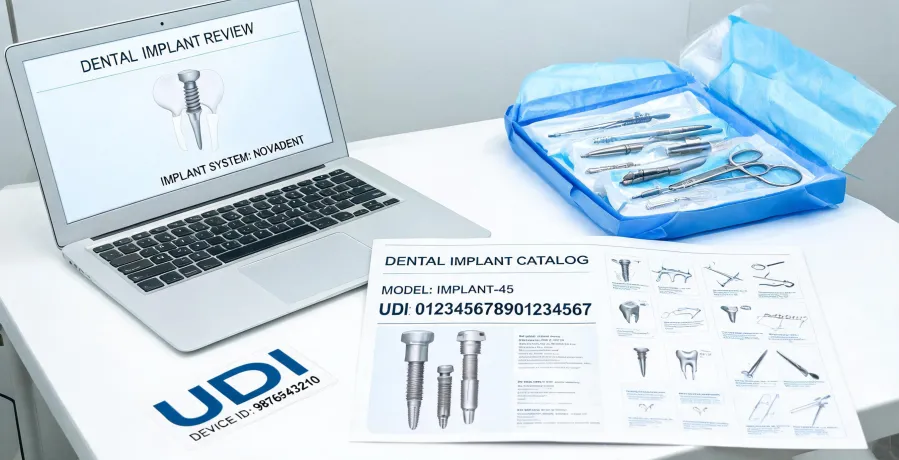
What struck me was not the clinical content. It was the packaging around it. The document had a clear revision number, a publication date, visual torque callouts, and checkpoints that matched the actual instrument order. I could validate every referenced SKU against our system without calling anyone. That's not common.
That is efficiency as a competitive advantage. Not in a sales sense. It means fewer callbacks, fewer returned instruments, and fewer awkward emails from a surgeon who saw something different in the patient's record. Efficient documentation doesn't make a surgeon better. It makes the system around the surgeon less fragile.
Why the Zimmer Biomet corporate office mattered
Before this, I had never contacted the Zimmer Biomet corporate office in Warsaw, Indiana, for a document review. I always went to the sales rep. The rep was good. But the process depended on the rep being good. When I finally asked the corporate office's documentation team for a current index of surgical technique guides, the response was straightforward. They sent a list with dates and told me where updates would appear. That was the moment I understood: a quality process should not rely on whoever happens to answer an email.
The CT scanner detour that made it click
Here is where the story turns in a direction I did not expect. The same week, the hospital procurement group asked me to help review two capital purchases: a CT scanner and a clinical chemistry analyzer. I almost said no. My background is implant quality, not radiology or lab diagnostics.
Then I looked at the spec sheets. The CT scanner quote included a detector configuration that didn't match the performance specs in the datasheet. Not all detectors are the same—that's probably obvious to a radiologist, but it wasn't to me. The clinical chemistry analyzer quote promised a throughput number calculated under optimal conditions, not under the lab's actual workload. The equipment might have been perfectly fine. The specifications were being compared on unequal terms.
The lesson wasn't about the vendors. It was about the process. I hadn't been trained to evaluate a CT scanner or a clinical chemistry analyzer. But I had been trained to ask questions: What version? What standard? What tolerance? Under what conditions? That discipline is the same whether the product is an Arcos femoral stem, a CT scanner, or a clinical chemistry analyzer.
What does a dental lab do?
A colleague once asked me, “What does a dental lab do?” I gave a lazy answer: “They make crowns.” Then I had to review a dental implant case and learned the real answer. A dental lab fabricates custom restoration components—abutments, crowns, surgical guides—that have to match an implant system's geometry to within fractions of a millimeter. The lab doesn't just make a part. It verifies dimensions, materials, and compatibility. That is quality control, and it is exactly what I do.
What I would do differently
If I were starting over, I would not wait for a near-miss to create a verification protocol. I would have a formal process for tracking document revisions from day one. We didn't have one before March 2024. Now every contract we sign includes a requirement for current documentation, and every review includes a version check against the manufacturer's published index.
I would also push back earlier on the assumption that quality is the quality department's job. A surgeon reading a surgical technique guide is doing quality control. A dental lab checking a crown against an implant is doing quality control. A hospital administrator reading a CT scanner spec is doing quality control. The title on the nameplate doesn't matter. The questions do.
For verification, I lean on ISO 13485:2016, the quality management standard for medical devices. It expects documented processes, risk management, and traceability. For imaging, the ACR CT accreditation program gives a useful baseline for acceptance testing. For lab analyzers, CLIA is the regulatory anchor. Each standard has a specific focus, but the underlying expectation is the same: verification, traceability, and accountability.
The real takeaway
Efficiency is a competitive advantage. I know that phrase sounds like a slide from a management training deck. I mean it in a narrower way: the faster you can verify an instruction, the more time you have to ask the next question. Teams that build verification into their workflow—manufacturer, distributor, hospital, dental lab—spend less time on fire drills and more time on problems that actually need judgment.
That doesn't make Zimmer Biomet or any other company perfect. I still find discrepancies. I still send inquiries. But I no longer assume that a famous name and a polished PDF mean the same thing as a current, verified document. I check. Then I check again. That's kind of boring. It's also the whole job.

Leave a Reply