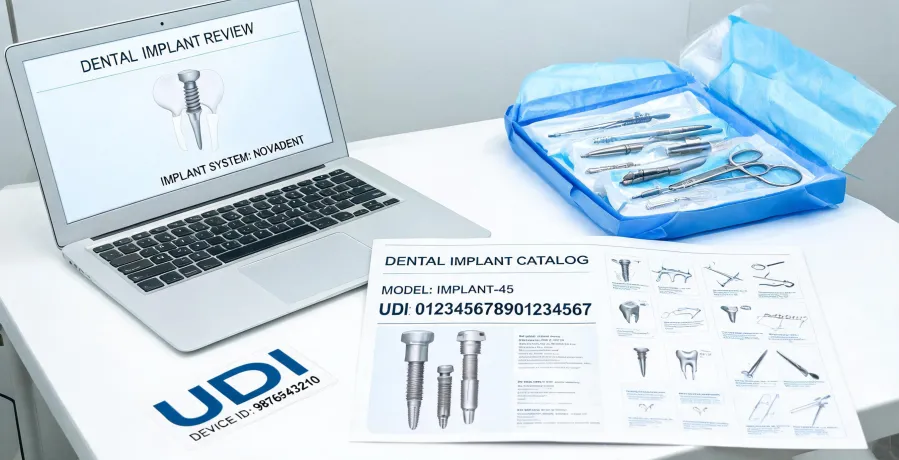
In medical device procurement, few phrases trigger a panic response like “it's on backorder.” I know because I'm the person who gets called after the normal process stops working. In my role coordinating emergency orders for hospitals, surgery centers, and dental clinics, I've handled 200+ rush orders in six years—including same-day turnarounds for cases that absolutely could not slip.
In March 2024, a hospital called at 11 a.m. needing a spinal implant set for a procedure the next morning. Normal lead time was five days. The first question wasn't “which product?” It was “do we go direct to the manufacturer or through a distributor?”
That question comes up more often than you'd think. And the answer isn't a loyalty test. It depends on speed, expertise, product complexity, and what can go wrong.
Direct vs. Distributor: What We're Actually Comparing
Direct from the manufacturer. What I mean is ordering through the official channel—for example, the Zimmer Biomet corporate website or their customer service line. A distributor is a third-party medical supply company that stocks inventory from multiple manufacturers and sells to healthcare organizations under contract.
Both routes can get you the same product. The difference is what happens between the request and the delivery.
Speed: Which Route Actually Delivers Faster?
Conventional wisdom says direct is faster because you're removing the middleman. In my experience, it's not that simple.
What most people don't realize is that a “direct” order often drops into the same fulfillment queue as every distributor order. The manufacturer isn't necessarily faster—it's just a different form. The real question is where the inventory sits.
Last quarter, we needed a blood pressure monitor for an outpatient clinic. The manufacturer's portal said “in stock, ships in 3–5 days.” A distributor 20 miles away had the same monitor on a shelf. We drove there and picked it up. Done.
For a spinal implant, though, direct usually wins. A spine case isn't a single part number. It's an implant family plus the instruments and sterile trays. A general distributor won't stock that depth of inventory unless they're highly specialized. Calling Zimmer Biomet's customer service with the surgeon's preference card narrowed the search in minutes. Even after the direct shipment left the warehouse, I kept second-guessing whether we'd confirmed the right size. The 14 hours until delivery were stressful. It arrived correct, but I've never stopped checking twice.
So my first lesson: speed is not about channel. It's about knowing where the inventory actually lives.
Expertise: The CPAP vs BiPAP Problem
Here's where procurement gets dangerous.
A clinician calls and asks for “a CPAP.” You look it up, price it, order it. Then the respiratory therapist calls back: “We didn't need a CPAP. We needed BiPAP.”
If you've ever wondered about CPAP vs BiPAP, you're not alone. CPAP delivers one continuous pressure. BiPAP delivers two pressure levels—one for inhaling and one for exhaling. I'm not a respiratory therapist, so I won't pretend to tell you which mode is clinically better. What I can tell you is that the words are not interchangeable, and the mistake rarely shows up until the device arrives.
A good distributor will often catch that. They've fielded the question enough times to ask “is this for obstructive sleep apnea or COPD?” A manufacturer's website won't ask you anything. It just adds the device to a cart.
Per FTC advertising guidelines (ftc.gov), as of February 2025, any claim like “clinically proven” or “better than” has to be backed by evidence. I use that as my filter. If a rep tells me a BiPAP is “better” than CPAP without explaining for whom, they're not giving me clinical guidance. They're selling.
Product Complexity: Spinal Implants Are Not Blood Pressure Monitors
A blood pressure monitor is a commodity. It has a standard spec, a UPC, and dozens of vendors. A spinal implant is the opposite. The implant, the instruments, the sterilization method, the surgeon's familiarity—everything matters. You cannot substitute one manufacturer's screw for another without a surgeon's approval.
That's why, for complex surgeon-specific products, I almost always go direct. A dental clinic taught me this the hard way.
The clinic needed a replacement instrument set for a Zimmer Biomet dental procedure. The distributor quoted two weeks. That would have meant cancelling fifteen procedures. A direct call to Zimmer Biomet dental customer service with the product code connected us to a specialized sales rep, who overnighted a loaner set. The procedures stayed on schedule.
Before that call, I used the Zimmer Biomet corporate website to verify the catalog number and download the surgical technique. That's another advantage of direct channels: they're not just order portals. They're reference libraries. You can check product codes, read IFUs, and see the full portfolio. That saves real time when you're on the phone with a customer service rep.
But direct isn't always simpler. Corporate portals are built for standard orders, not edge cases. When you need a loaner, a swap, or a compatibility check, a human with a phone number beats a website every time.
Cost and Risk: The Hidden Fees No One Talks About
People assume direct means lower price because there's no distributor margin. Sometimes that's true. But not as often as you'd think.
A distributor's price includes service, inventory risk, and local availability. They may also have a system contract with the manufacturer that gives them better pricing than a straggler calling from the website.
I remember one $15,000 spinal implant order where the distributor's quote was $600 less than direct. The direct order would have shipped faster. The distributor order was cheaper. We needed both, so we split the difference: implant direct, instruments through the distributor. It worked, but it required two coordinated shipments and a lot of phone calls.
Looking back, I should have asked about contract pricing up front. At the time, I assumed no middleman meant no markup. That was my mistake.
I want to say the rush fee was around $800—don't quote me on the exact figure. But the larger point is: no matter which channel you choose, compare total cost. Include expedited shipping, loaner charges, sterilization handling, and the time your staff spends chasing delivery status.
Which Should You Choose? My Honest Answer
If the item is a commodity—a blood pressure monitor, basic instruments, standard disposables—use a distributor. They're faster, cheaper, and have the local relationships to solve problems.
If the item is a surgeon-specific implant—a spinal implant, a joint replacement system, a complex dental case—go direct. Use the Zimmer Biomet corporate website to verify specs, then call Zimmer Biomet dental customer service (or your implant company's equivalent) to confirm inventory and loaner availability.
If you're not sure whether the respiratory device should be CPAP or BiPAP, stop before ordering. Talk to a human. Ask the clinician to confirm the indication, the pressure settings, and the patient interface. A 5-minute phone call can prevent an $1,800 mistake that shows up at a patient's bedside.
The medical device industry is evolving. What was best practice in 2020—call your distributor and wait—can cost you a contract in 2025. But the fundamentals haven't changed: know what the clinician needs, verify the product code, and confirm inventory in writing. I've been burned enough times to say this plainly: I do not trust any inventory count until I see it in writing.

Leave a Reply